can airboats tip over?
Airboats look top-heavy and loud, but tipping over is rare. Here is how the hull design, operator safety rules and Coast Guard-certified captains keep Louisiana airboat tours upright.

can airboats tip over?
No commercial airboat tour in the New Orleans area has a pattern of tipping over, and the physics of the boat explain why: a flat hull as wide as it is long spreads the weight, the engine sits low in the center, and the passengers sit between them. What actually hurts people on airboats is falling objects, noise, and jumping between seats, not capsizing. Operators treat the tip-over question as settled and design their rules around the real risks.
That answer surprises people who see an airboat for the first time. The boat looks like a shoebox with an airplane engine bolted on the back, and the cage around the propeller looks like it should drag the whole thing over. In practice the opposite is true. The flat bottom is the stability, not the weakness.
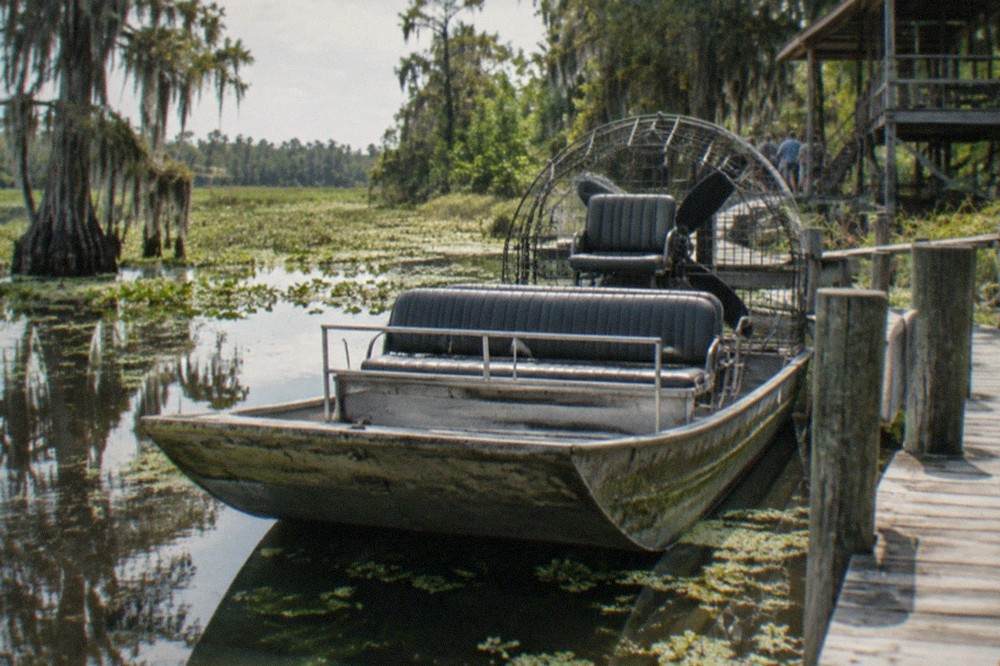
Airboats were built for exactly the water you ride them on here: inches-deep marsh, floating grass, and cypress stumps that would shred a normal propeller-driven hull. A conventional boat needs enough water to float its draft. An airboat needs almost none, because the hull is a flat sled that slides over the surface on a cushion of air and its own momentum. That same flatness is why it does not roll.
The question is worth taking seriously anyway, because the honest answer has conditions. A commercial tour with a licensed captain is one thing. A privately owned airboat in inexperienced hands is another, and Louisiana's accident record, like Florida's, comes almost entirely from the second category. The distinction between the two is the whole story of this article.
If you are comparing the ride styles before you worry about the physics, the airboat versus covered boat comparison breaks down speed, price, and wildlife viewing side by side.
How does an airboat hull stay upright?
An airboat stays upright because its center of gravity sits low and central: the heavy engine and propeller sit over the hull's midpoint, passengers sit in the middle row, and the flat, wide bottom resists rolling the way a sled resists tipping sideways. There is no keel and no deep draft, so there is very little for the water to grab and roll. The trade-off is that the boat turns by sliding, not by leaning.
Start with the hull. It is a flat or slightly vee'd aluminum pan, rectangular, with sides that rise maybe eighteen inches to two feet. Nothing hangs below the waterline. When the boat is at rest it floats like a raft, and a raft is one of the hardest things in the world to flip in calm water because every extra passenger just pushes it flatter into the water.
The engine is the heaviest single component, and it sits in the middle of the boat, not the front or back. The propeller cage rises above it, which is what makes the boat look top-heavy, but the cage is aluminum tubing, light for its size. The passengers sit in rows ahead of the engine, low in the hull, often on bench seats with a low center of gravity. Every person who boards makes the boat more stable, not less, up to its rated capacity.
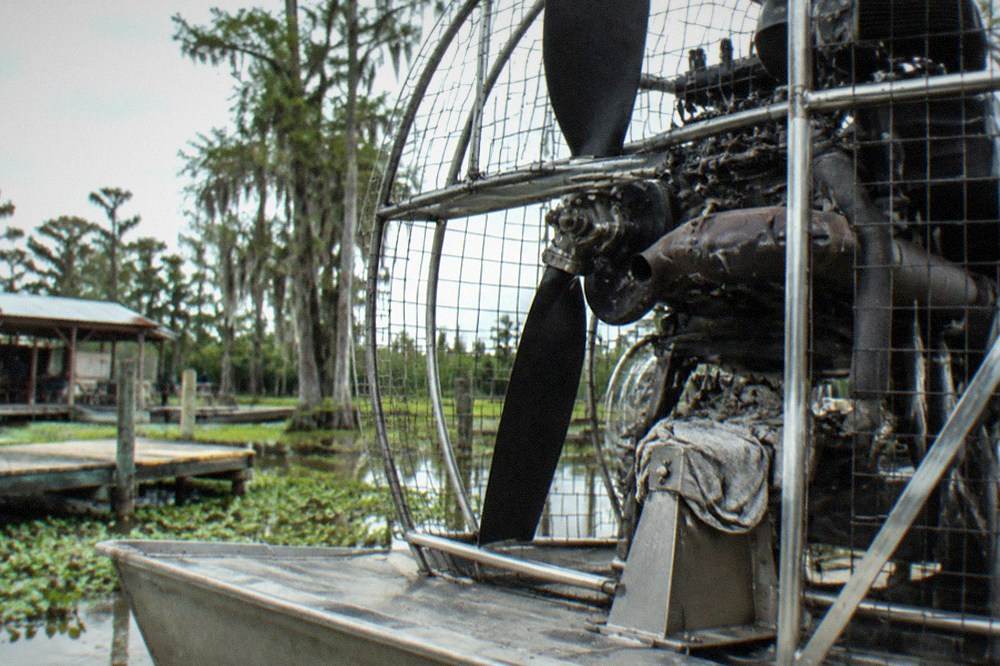
Steering is where airboats differ from every boat most people have ridden. There is no outboard motor swinging a propeller in the water. The captain steers with rudder sticks, vertical vanes held in the propeller wash behind the cage, plus throttle. Push the stick and the boat turns by skidding its flat bottom across the surface. In a sharp turn the boat slides rather than heels over, which feels strange the first time, because your body expects a boat to lean like a sailboat. It does not. The flat hull and the sliding turn are the same design choice made twice.
The one real stability limit is weight distribution. Because the hull is flat, loading one side heavily does matter, and this is why operators seat people deliberately rather than letting groups cluster. Airboat Adventures, which runs from Lafitte on the west bank, caps its boats at 6 passengers on premium small airboats, 10 on regular small airboats, and 30 on large airboats, with captains certified by the U.S. Coast Guard, per its own FAQ. Those numbers are not comfort guidelines, they are the loading the boat was built and rated for.
Who is not allowed on an airboat?
Airboat operators in the New Orleans area restrict pregnant women, children under 5, and anyone with neck or back injuries from riding, and guests must be able to board the boat unassisted. These rules come straight from the operators' own published policies, and they exist because an airboat ride is a sustained vibration and sudden deceleration experience, not because the boat might flip. If any of these describe someone in your group, a covered pontoon boat is the standard alternative.
The pregnancy restriction is the one people ask about most, and the answer deserves to be plain. Airboat Adventures states it directly: pregnant women, children under 5, and anyone with neck or back injuries are not allowed on airboats, and riders must be able to board unassisted. The reason is mechanical. An airboat hull takes every wave, wake, and floating log as a jolt transmitted straight through the flat aluminum bottom into the seat. There is no suspension. Over a 45-minute or 90-minute ride that is a lot of repeated impact for a spine that is already vulnerable, and operators are not equipped to assess individual risk on the dock.

The age floor for small children follows the same logic. A five-year-old's neck and the sharp stop of an airboat are a bad combination, and the noise is a genuine factor as well, which brings up the next section. Note that the age cutoffs vary by operator and by boat size: Cajun Encounters, for instance, prices its VIP small-boat swamp trips at 13 and up, while the covered pontoon boats at several operators take all ages, with infants riding free at Jean Lafitte Swamp & Airboat Tours.
Here is how the three main airboat experiences in the New Orleans area compare on the restrictions and figures that matter for a safety decision:
| Tour | Boat size | Price | Rating and reviews | Pickup option |
|---|---|---|---|---|
| Airboat Adventures (Lafitte) | Large and small airboats, 6 to 30 passengers | $50 | 4.7 from 5,215 reviews | Transport option available |
| Louisiana Tour Co high-speed airboat (Marrero) | 9-passenger small boat | $89 | 4.9 from 1,004 reviews | Pickup optional at checkout |
| Small-group airboat with pickup | Small boat, downtown round-trip transport | $115 | 4.9 from 1,763 reviews | Round-trip included |
If you are planning around these restrictions, the swamp tour with kids guide covers which boat styles work for which ages, and the what to wear on a swamp tour guide handles the practical clothing questions, including why ear protection matters more than you think.
Is the noise the real risk?
Yes, in the sense that noise is the only hazard every single airboat passenger is guaranteed to face. The propeller behind the cage runs at aircraft volumes, which is why every commercial operator hands out ear protection before departure and why pets are barred from most airboats. Hearing damage is cumulative and permanent, and the operators treat it as the primary safety conversation, ahead of any talk of capsizing.
The propeller is doing the work of an outboard engine in open air, a few feet behind your head. Airboat Adventures notes that pets are not allowed on its airboats partly for this reason, and provides hearing protection to every guest. Wear it for the whole ride, including the slow scenic stretches, because the propeller does not stop turning just because the boat has slowed down.
This is also where the covered pontoon comparison becomes a real decision rather than a preference. A pontoon boat with a quiet outboard motor lets you hear the guide's narration, the birds, and the water. An airboat trades all of that for speed and reach into water a pontoon cannot enter. Neither is wrong, but if you are traveling with someone sensitive to noise, a small child, or a person who cannot wear earplugs comfortably, the trade is not worth forcing.
Do weather and water levels change the answer?
They change the ride, not the tip-over math. Rain does not cancel airboat tours, only lightning does, and operators run year-round in heat, mist, and post-storm chop. High water in spring can close swamp access roads and change which channels a captain can use, and low water in late fall can leave some areas too shallow even for an airboat, but in every case the operator reroutes rather than risks the hull.
The weather policy at the covered-boat operators is blunt: tours go out rain or shine, and only lightning stops the boats. Airboats follow the same logic. The flat hull does not care about a summer shower. What a captain does care about is wind on open water, because an airboat has almost no freeboard, the height of the hull's side above the water, and a stiff crosswind on a large open pond is the one condition where an experienced captain slows down and picks a sheltered route.
Water level is the Louisiana variable nobody controls. The Pearl River gauge at Pearl River town closes Old Highway 11 at 16.5 feet, and the spring and early summer of 2026 saw the Pearl River Wildlife Management Area's access roads go under water more than once, closing the adjacent shooting range and parts of the Honey Island area. The Maurepas Swamp wildlife management area runs its own gauge-linked rules for boat traffic. None of this makes an airboat more likely to tip; it makes some launch points temporarily unusable, and operators shift to channels that are open.
The practical takeaway for a visitor: book the tour you want and let the operator worry about the route. If conditions genuinely prevent a safe trip, the operator cancels or reschedules, and the cancellation terms in the next section are what protect your money.
What do the booking terms say about safety?
The cancellation and restriction policies are where an operator's safety claims become enforceable, and the New Orleans-area airboat operators publish clear ones. Airboat Adventures makes reservations within 24 hours final and offers an optional Trip Protection fee at 10 percent of the booking that allows cancellation or rescheduling up to 1 hour before departure. Jean Lafitte Swamp & Airboat Tours requires 24 hours' notice for refunds and keeps tickets transferable for a full year.
Reading a cancellation policy before you book tells you how an operator thinks about risk. A 24-hour final window means the operator is holding a seat it cannot resell, which is why the Trip Protection option exists at Airboat Adventures: it converts a firm reservation into a flexible one for a known fee. Jean Lafitte Swamp & Airboat Tours takes the other approach, making tickets transferable and valid up to one year, so a missed tour becomes a future tour rather than a lost payment. Neither policy mentions tipping over, because neither operator treats it as a live risk worth insuring against.
One more clause worth knowing before you ride: airboat operators state plainly that they are not responsible for cameras, phones, and glasses lost to water, splash, or rain. An airboat ride is a wet ride, and anything not strapped down will eventually test the swamp's grip. Dry bags and lanyards are cheaper than phones.
Which airboat tour should you actually book?
For a first airboat ride from New Orleans, the Airboat Adventures tour from Lafitte is the standard choice: from $50 per person, rated 4.7 across 5,215 reviews, with a transport option from downtown hotels. If you want a smaller, faster boat, the high-speed 9-passenger airboat from Marrero runs $89 and holds a 4.9 from 1,004 reviews.
The Airboat Adventures ride is the one most first-timers should take. The operator has run airboats on the west bank for decades, its captains are certified by the U.S. Coast Guard, and its base at 5145 Fleming Park Road in Lafitte sits on the edge of the same wetlands that surround the Barataria Preserve. The roster price is $50 for the tour-only option, with round-trip hotel transport available for $30 per person extra, and pickup starting an hour and fifteen minutes before departure.
The Louisiana Tour Company's high-speed 9-passenger boat out of Marrero is the step up: fewer passengers, a 4.9 rating across 1,004 reviews, and a $89 price that reflects the smaller boat. For travelers without a car, the small-group pickup option bundles the small-boat experience with round-trip downtown transport for $115, and its 4.9 across 1,763 reviews is one of the strongest signals in the airboat category.
For the pickup-included version, the small-group airboat with downtown transport is the one to check: it pairs the small-boat ride with round-trip service from the French Quarter area, so the whole outing is door to dock and back.
Whichever you choose, the booking terms above apply, so read the cancellation window before you pay. And if you want the full field, including the covered boats that take all ages, the best swamp tours in New Orleans guide ranks every style side by side, and the New Orleans Swamp Tours homepage compares all nineteen tours on the roster in one table.
Common Questions About Airboat Safety
can airboats tip over?
Commercial airboat tours very rarely tip over. The flat, wide hull, the low central engine placement, and the sliding turn design all resist rolling. The injuries that do occur on airboats come from noise, loose objects, and moving around during the ride, not capsizing.
Are airboats safe for pregnant women?
No. Airboat Adventures, like other area operators, does not allow pregnant women, children under 5, or anyone with neck or back injuries on its airboats, and riders must board unassisted. A covered pontoon swamp boat is the standard alternative, since its hull absorbs far less impact.
Do airboats have seat belts?
Most commercial passenger airboats use low bench seating rather than seat belts, because the ride's hazard is jostling rather than a collision. Stay seated for the entire ride, keep hands inside the boat, and hold children by the base of the life jacket if the operator provides one.
Why do airboats have a cage around the propeller?
The cage keeps passengers, wildlife, and branches away from the propeller, which turns at aircraft speeds inches from the seating area. It also protects the propeller itself from floating debris. Never touch the cage during a ride, and never lean toward it for a photo.
Can airboats operate in shallow water?
Yes, that is their entire purpose. The flat hull slides over inches of water and even moist marsh grass that would ground a conventional boat. This is why airboats can reach areas of the swamp that covered pontoon tours cannot enter.
Is ear protection provided on airboat tours?
Yes. Operators provide hearing protection before every airboat departure, and wearing it for the full ride is strongly advised, since the open propeller runs at aircraft volumes. Pets are barred from most airboats partly for the same reason.